




Blog
Resolving Banking Disputes Without Court: The Real Impact of ADR

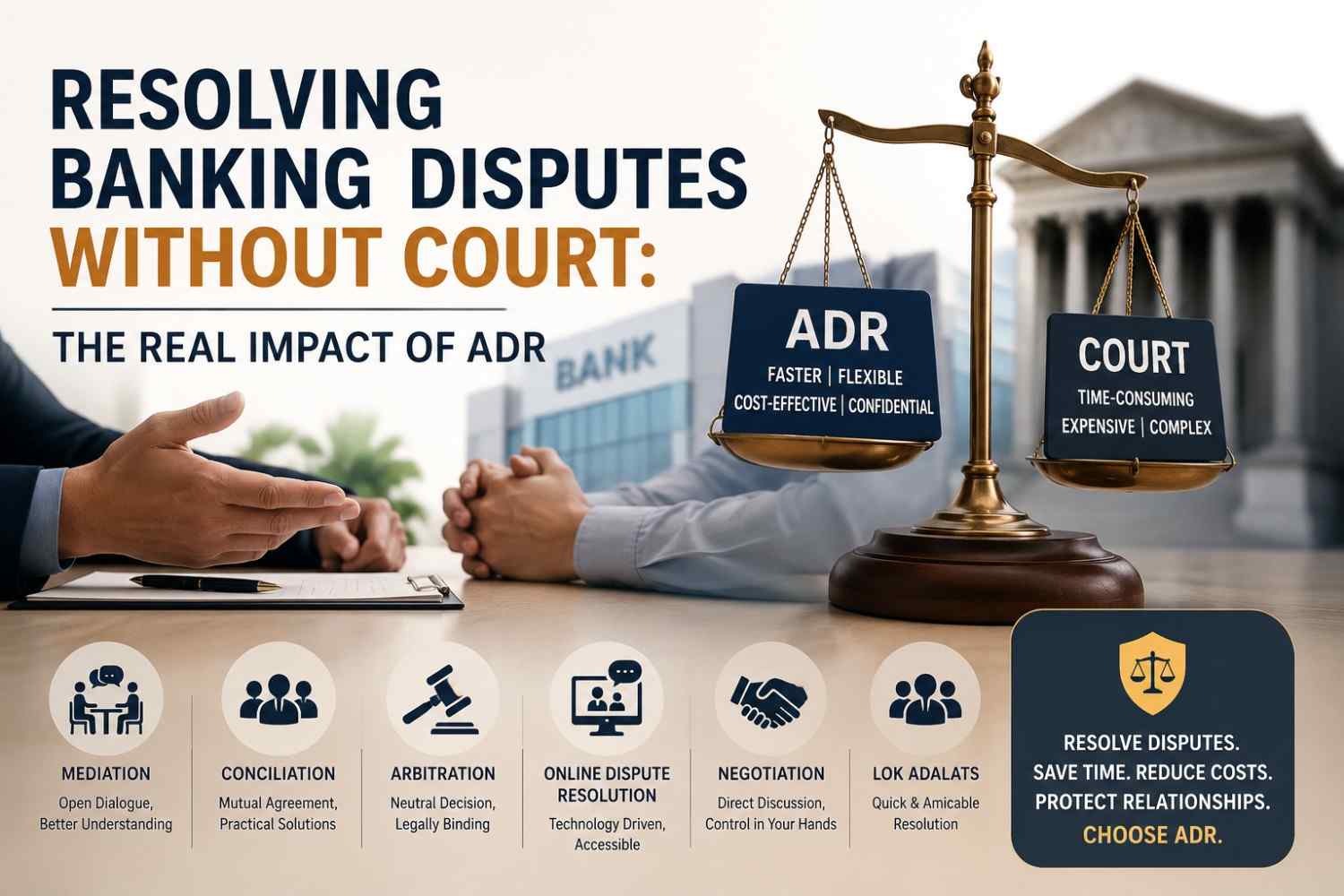
The financial sector acts as a catalyst for economic growth, investment, and wealth creation. The increasing volume of disputes in the banking and financial sector has significantly increased due to the rise in digital transactions and growing reliance on financial services.
Certain ADR methods such as arbitration, mediation and conciliation offer a structured way for resolving conflicts not by traditional court proceedings, hence reducing the judicial burden on the system and ensuring a faster solution than traditional court proceedings. ADR methods are being widely used because traditional litigation processes are time-consuming, costly, and complex, making it difficult for the parties to seek justice at the time.
One of the primary advantages of ADR in financial disputes is confidentiality because financial institutions often prefer to resolve disputes cautiously to protect their reputations and maintain customer trust. The establishment of the India International Arbitration Centre (IIAC) reflects the government’s commitment to positioning India as a hub for international arbitration. The regulatory framework established by the RBI, SEBI and other authorities provides a solid foundation for the growth and development of ADR mechanisms in the financial sector.
Importance of ADR in Banking and Finance
1. Efficient and Cost- Effective
Traditional litigation is often characterised by lengthy legal procedures, legal representation costs and high court fees which can be burdensome for both financial institutions and their clients. ADR such as arbitration, mediation and conciliation offer a streamlined process that allows disputes to be resolved more quickly and at a lower cost.
2. Confidentiality and Preservation of Reputation
Court proceedings are conducted in open court, making the details of the dispute and the judgment part of the public record.
Financial institutions prefer ADR because confidentiality is a crucial factor in financial disputes, as the public disclosure of sensitive information can damage the reputation of the financial institution, which can erode the trust of the customer.
3. Lowers the burden on the Judicial System
The increase in the volume of digital transactions and use of financial institutions has led to an increase in Financial disputes, which has contributed to the backlog of cases in courts, leading to delays in justice and increased stress on the judicial System. So, by resolving the disputes outside the court system, ADR helps the judicial system to focus on more complex and high-priority cases and thus reduces the stress on the judicial system.
4. Flexible and Specialized
Courts are governed by rigid procedural rules; ADR offers greater flexibility compared to traditional litigation as it allows the parties to customise the dispute resolution process according to their specific needs. The choice of arbitrators, arrangement of hearings, and the applicable rules of evidence are agreed by the parties. So, it provides a better flexibility in comparison with court procedures.
Types of ADR Mechanisms in India
There are several ADR mechanisms widely used in India, but some of the main ones are:
1. Arbitration
Arbitration is one of the most commonly used methods in ADR. It seeks to resolve commercial and banking disputes. In arbitration, when two parties have a dispute, they decide to refer the case to a neutral third person called an arbitrator. In this, instead of going to the court, the arbitrator hears both sides, analyses the evidence and gives a decision known as an arbitral award. The process is faster, more confidential and more flexible than litigation.
2. Conciliation
Conciliation is another method of ADR, and it is different from arbitration. In conciliation, the conciliator doesn’t decide the dispute. Instead, they help the parties communicate and negotiate so they can reach a mutually acceptable settlement. The conciliator plays a crucial role in facilitating discussions between the parties, identifying the real issues causing the dispute, suggesting possible solutions and encouraging both parties to arrive at a mutually acceptable agreement.
Conciliation is more flexible and cooperative as the parties decide whether to accept a settlement.
3. Mediation
One of the most popular and widely used methods of Alternative Dispute Resolution is Mediation. In mediation, a neutral third person known as a mediator helps the parties who are in dispute communicate and negotiate. The Mediator doesn’t force any solution or decide the dispute but helps the parties to understand each other’s concerns, identify the real interests and analyse the possible solutions.
The parties voluntarily reach the agreement. Mediation is like a win-win solution rather than determining a winner or loser, as in mediation the parties reach the settlement through mutual consent.
4. Negotiation
Negotiation is the most informal and simple method of ADR. There is no third party involved in negotiation, unlike mediation, conciliation and arbitration. Negotiation is usually the first step before the parties choose any formal dispute resolution process. The entire process of negotiation depends on the willingness of both parties to cooperate and compromise. The parties discuss their issues, make offers, counteroffers and try to reach a mutually acceptable solution.
5. Lok Adalats
Lok Adalats, commonly referred to as People’s Courts, are established under the Legal Service Authorities Act, 1987, to provide quick, inexpensive settlement of disputes. They encourage the parties to resolve their differences through mutual agreement rather than adversarial litigation. Banks and financial institutions frequently participate in National Lok Adalats to resolve loan recovery matters, credit card dues and other financial disputes through negotiated settlements.
Online Dispute Resolution (ODR) in Banking and Finance
Online dispute resolution is a modern extension of ADR. It is a technology-enabled form of Alternative Dispute Resolution. The banking and finance sector generates a high volume of disputes, including failed digital payments, loan recovery issues, card disputes, service deficiencies and consumer complaints. While ADR traditionally includes negotiation, mediation, conciliation and arbitration outside the courtroom, ODR uses online tools to conduct the same processes more efficiently. ODR uses digital platforms, video conferences, electronic document exchange and automated case management systems to provide faster, more accessible and efficient resolution.
ODR is especially useful in banking and finance because disputes often depend on transaction records, digital communication and timestamps, all of which can be managed electronically. The RBI requires payment system operators to establish transparent, rule-based and user-friendly ODR mechanisms with minimal manual intervention. Customers whose grievances remain unresolved may further approach the Reserve Bank-Integrated Ombudsman Scheme,2021.
Institutional Framework for ADR in Banking and Finance
Several specialised institutions have been established for the resolution of banking and financial disputes through compromise and conciliation. These institutions reduce litigation, promote timely settlements and strengthen confidence in the financial sector.
1. Lok Adalats
Lok Adalats are established under the Legal Services Authorities Act,1987. Lok Adalats provide a platform for resolving financial disputes through conciliation and settlement.
People’s courts are specifically effective in resolving small-value financial disputes involving loans, debt recovery and service deficiencies.
Banks and financial institutions frequently participate in Lok Adalats to facilitate the quick and effective settlement of non-performing assets and recover outstanding dues.
2. Debt Recovery Tribunal (DRTs)
Debt Recovery Tribunals were established under the Recovery of Debts and Bankruptcy Act,1993. It ensures speedy resolution and recovery of debts owed to banks and financial institutions. DRTs have the authority to enforce the loan agreements and issue recovery certificates. DRTs have reduced the burden on civil courts and improved efficiency of financial dispute resolution. The simplified procedures and cost-effective dispute resolution make Lok Adalats an attractive forum for settling banking and financial disputes.
3. ADR under SEBI
To address the conflicts arising in the securities market, the Securities and Exchange Board of India has established a structured dispute resolution framework. Under SEBI’s regulatory supervision, investors, brokers and other market participants may resolve disputes through arbitration and conciliation.
Challenges in ADR
There are several challenges associated with ADR that prevent it from being fully effective.
1. Lack of awareness and Knowledge
In rural and economically weaker sections of society, many people and litigants are unaware of ADR mechanisms such as mediation, arbitration and conciliation. This lack of awareness results in underutilization of ADR mechanisms.
2. Preference for Conventional Litigation
Despite the increasing recognition of ADR, many litigants continue to prefer traditional litigation due to familiarity with the processes. However, the limited exposure to ADR
procedures and inadequate training have raised hesitation in recommending or actively participating in mediation, conciliation and arbitration proceedings.
3. Enforcement Issues
Even after obtaining an arbitral award or mediated settlement, the losing party can challenge the award before the courts, which can lead to difficulties in enforcement.
4. Confidentiality Concerns
Although ADR proceedings are generally confidential, concerns remain regarding data protection and the handling of sensitive financial information, particularly in digital dispute resolution.
5. Accessibility and Affordability
ADR is generally less expensive than court litigation. However, factors such as geographical remoteness, language barriers and inadequate ADR infrastructure continue to restrict access to these dispute mechanisms.
Recommendations
To address the challenges associated with ADR mechanisms in India, several measures can be taken:
- Training programs and workshops should be conducted to educate lawyers, judges and the public about the benefits and procedures of ADR.
- ADR should not become as complicated as litigation. The steps and the procedures should be made simpler and user-friendly.
- ADR in banking often involves complex financial documents, loan terms and digital transactions, so neutral decision-makers should have domain expertise.
- The Process of ADR should mention clear rules, reasoned decisions and equal opportunity to present evidence so that customers trust the mechanism.
- ODR systems can reduce the delay, lower the costs and make dispute resolution more accessible for digital banking complaints.
Conclusion
ADR has become an essential mechanism for resolving banking and financial disputes in a faster, more efficient and less adversarial manner than traditional litigation. While ADR provides the core framework through negotiation, mediation, conciliation and arbitration, ODR modernises that framework through digital platforms by enabling dispute resolution. These mechanisms reduce litigation costs, save time, enhance customer access and strengthen trust in the financial system.
One of the key benefits of ADR is that it provides efficient solutions to complex disputes in the banking and financial sector. Unlike Conventional litigation, which often results in rigid judgments, the specific needs and interests of the parties involved are addressed by the ADR mechanisms, which allow for creative and flexible resolutions. While challenges remain in the enforcement of settlements and the complexity of financial disputes, regulatory support and capacity building for ADR professionals can further strengthen the effectiveness and credibility of ADR in the financial sector.
Financial Institutions must make use of new technologies and keep up with the changing trends in dispute resolution, ensuring that the process remains fair, transparent and ethical.
A settlement must be lawful, documented and transparent – a principle that Trust Law Associates strongly emphasises.
Prepared by Trust Law Associates
Banking, Finance, Dispute Resolution, and Loan Settlement Advisory
New Delhi, India
Contact: +91 7498418768 | contact@trustlawassociates.in
Address: 1st Floor, Property No. 102, Above Bank of Baroda, Adarsh Mohalla, Patparganj, Mayur Vihar, New Delhi, Delhi, 110091